
Ukraine's War Just Entered a New Phase
Starshield? Throttled. Missile interceptors? Delivery paused. Intelligence sharing? Disputed. The Ukraine war has changed dramatically over the past week, putting Russia in its most favourable position in years. And the fallout reaches far beyond Ukraine: for Europe's credibility, and for every country relying on American technology.
Expert Perspective: Analysis by Abishur Prakash ("Mr. Geopolitics"), one of the world's leading geopolitical speakers and author of six books, advising companies on the fractured world. Prakash delivers keynotes in Toronto, NYC, London, New Delhi, and worldwide.
Full transcript: Abishur Prakash ("Mr. Geopolitics") on the future of the Ukraine war
America Has The Off Switch
Europe has paid for Patriot missiles to defend Ukraine. Those missiles could be in Ukraine today, but they're not moving because Washington hasn't said yes. Europe has the money. Ukraine has the need. America has the off switch.
What has taken place in the past week fundamentally changes the future of the war between Ukraine and Russia, which is now in its fifth year. What has taken place points to the nature of the war completely changing.
First, there was the Patriot missile defense situation, where Ukraine has run out of interceptor missiles. The Russians effectively have carte blanche over Ukrainian skies. Ukraine is unable to defend itself against Russian ballistic missiles striking Ukrainian cities and Ukrainian critical infrastructure. The missiles have been paid for under a NATO agreement. Europe has paid for them, but Washington hasn't given the approval for those missiles to be delivered.
Then there's what took place with Starshield, the military version of Starlink, where the supply of Starshield to the Ukrainian military was severed, and there's complete ambiguity as to who did this. The reporting suggests this came from the White House. The White House is putting some of the spotlight on Elon Musk. Elon Musk is putting the spotlight on the Pentagon. A group of US senators is asking for clarity and is almost launching an investigation into how and why Ukraine lost access to Starshield. And because Ukraine lost access, according to one Ukrainian commander, dozens of his armed drones, which were about to strike Russian military targets, simply fell out of the sky.
In addition to that, intelligence sharing between the US and Ukraine appears to have also been paused, creating a new challenge for the Ukrainian military in reconnaissance and in choosing which targets to strike. And the relationship between President Trump and President Zelensky is imploding again right before our eyes. We all saw the flare-up in the Oval Office last year. This is all happening again.
That's the state of play in the Ukraine war right now. This has not happened before: all of these moving parts together at the same time. And they paint a bleak picture for Ukraine and for Europe.
The Strategy Behind The Pause
The biggest risk right now is that Ukraine surrenders and the Russians achieve victory. And that is exactly the strategy behind halting the Patriot missiles to Ukraine. The US strategy is very simple. If Ukraine cannot defend itself, and if Ukraine cannot strike Russia because Starshield is being disabled, then suddenly the optics for Moscow completely change. The Russians have carte blanche. The Russians appear to have the upper hand. Russian cities are not coming under fire. And optics is 90% of geopolitics.
If the Russians have the optics in their favor, they may very well negotiate an end to this war from a position of strength, on terms favorable to the Kremlin, like freezing the borders, with the Donbas and Donetsk going to Russia, officially or unofficially. And the war ends with Russian cities like Moscow and St. Petersburg, and companies like Wildberries or Yandex, no longer being hit left, right and centre, as they have been.
So this is not a sudden shift with no logic. The US pausing the supply of interceptor missiles and halting Starshield is a deliberate move to bring Russia to the negotiating table. That's the biggest takeaway from the past week.
Trump, Zelenskyy & Ukraine's Politics
Then there's the Trump-Zelensky relationship, which is again on incredibly shaky ground, but this time it's taking place against the backdrop of Ukraine not being able to defend itself. We haven't seen that before.
If the situation escalates between Trump and Zelensky, pressure may rise from the US and certain European governments for Zelensky to resign and for Ukraine to hold elections. The trade may be: if you want US or Western military assistance to fight Russia in the current war, or to defend against Russia after the war is frozen, change the government. So Ukraine's national politics are very much part of what's taking place right now.
Europe's Credibility Is On The Line
Third is what this means for Europe. European credibility is on the line. If the US pausing the Patriot interceptor missiles and Starshield is single-handedly what causes Ukraine to surrender, or to sign unfavorable terms to end the war, then what good is European support? What exactly has Europe been supplying the Ukrainians with, other than financing the purchase of American military hardware?
If the Europeans are unable to step up and fill the gaps left by US interceptor missiles and US space and satellite technology, they are simply observers, because they have nothing to replace the American options with. The message to the world is that if Europe can't help Ukraine in Europe, how is Europe going to help anybody else across the globe? So Europe's perception is deeply affected by what takes place in Ukraine next.
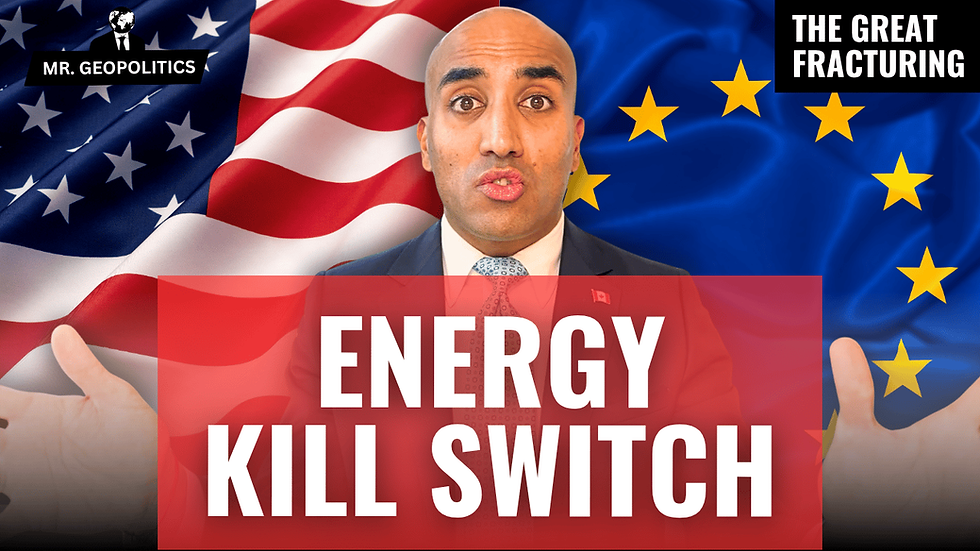
America's Kill Switch
Fourth is the switching off of Starshield. From the US point of view, it may be a power move, a deliberate attempt to bring the Russians to the negotiating table, because the Ukrainians cannot strike Russia effectively without US satellites and US space internet.
But for the rest of the world, it carries a deeply uncomfortable message. Take India, which is being pressed to purchase more US technology as part of a potential US-India trade deal. Whoever purchases American technology now will be very uncomfortable knowing that the US has an off switch, a kill switch. If the geopolitics does not favor Washington, the US government, the Pentagon or a private American technology firm may cut the flow of that technology to a specific geography, government or society.
That is how many governments around the world will view the severing of Starshield, even though it was momentary: as a sign that American technology may not be safe, and that its supply, especially in critical moments like war, may not be guaranteed. That is a huge shift in the perception of US technology exports and US platforms, especially when it comes to national security.
Europe After The War
The last key shift is what Europe's geopolitical situation looks like post-war. If what the US is doing ends the war, specifically with Ukraine forced to surrender because it has no other choice and the Europeans can't help, there is complete ambiguity about what Europe's post-war landscape looks like.
Since 2022, European nations have been brought together by the war in Ukraine. The war has acted as a geopolitical glue, bringing most Western nations onto the same page about who the adversary is and how to tackle it, through sanctions, energy decoupling and more. Once the war ends, that glue disappears, and it's uncertain whether European nations will remain aligned or begin to fracture and go in different directions.
Perhaps more important, from Germany to Poland to Lithuania, many European governments, watching growing episodes of hybrid warfare, Russian shadow fleet ships launching drones, and the Russian military probing NATO's borders, are becoming convinced that a war with Russia is increasingly likely. And if the war in Ukraine ends, that next collision may take place when Russia is no longer isolated: trading with the United States, China, India and the Middle East, with Russian energy back online, Russian diesel supplied to global markets as is beginning now, and the Russian government back at global forums like the G20, all while Russia collides with NATO in Europe. It's a very different environment that may form based on what happens in Ukraine next.
Part of a Pattern
So what has happened over the past week is not isolated. It's part of a pattern, part of a geopolitical strategy, and it signals to the world that, first, America's support is not forever, and second, there really is no alternative, at least in the West, to what America offers. All of that is on the line.
I hope you resonated with today's video. Leave your thoughts below on whether you think the war in Ukraine will end based on these changing circumstances, or whether it may be about to expand to a new front.
Book Abishur Prakash for Geopolitics Speaking & Podcasts
Events/Public Speaking: Want Abishur Prakash discussing geopolitics (and the future) at your next event? Click here.
Podcasts: Interested in bringing "Mr. Geopolitics" as a guest on your podcast to discuss the changing world? Book him here.
Join the Mr. Geopolitics community below!


Comments